I stared at the crumpled paper resting on my dining table. My June electricity bill from HESCOM felt like dragging concrete uphill. Five thousand rupees.
Why? Because I missed a single, obscure checkbox.
That was my brutal, unforgiving initiation into the Karnataka government Gruha Jyothi scheme. Everyone cheered when the initial announcement hit the regional airwaves. Free power for millions.
But the administrative reality is a completely different beast entirely. It bites hard.
We were promised a seamless transition to zero-cost electricity. The political speeches painted a picture of absolute relief for the common household.
And yet, my neighbors in Belagavi and I found ourselves utterly paralyzed. We spent entire weekends fighting with a digital interface that refused to cooperate.
So, I decided to dissect the entire apparatus. I wanted to understand exactly where the wires were getting crossed.
What I found was a labyrinth of bureaucratic tripwires. Most applicants are completely blind to them.
The Mathematical Illusion Behind the Karnataka government Gruha Jyothi scheme
The fundamental premise sounds incredibly simple on paper. Consume under 200 units, pay nothing.
But the execution relies on a deeply convoluted mathematical formula. The energy department doesn’t just look at your current meter reading.
They calculate your monthly average over the previous financial year. Then, they tack on a ten percent buffer.
That arbitrary number becomes your personal, inescapable ceiling. It traps you in your past consumption habits.
If your historical average was 70 units, your new limit is 77. Use 78 units next month?
The hammer falls. You pay the entire bill, down to the last rupee.
A total disaster.
People who frugally saved energy last year are actively punished today. They have virtually zero margin for error during the sweltering summer months.
Calculating Your True Cap in the Karnataka government Gruha Jyothi scheme
Let us look at the actual math that dictates your fate. I pulled out my old bills from 2022 to figure this out.
My family was out of town for three months that year. Our house sat empty, drawing almost zero power.
Because of those dead months, my annual average plummeted to a meager 55 units. My new state-mandated allowance became roughly 60 units.
I bought a new refrigerator in May. That single appliance pushed my monthly usage to 90 units.
I was suddenly disqualified from the very initiative meant to save me money. Millions of residents are currently falling into this exact same mathematical sinkhole.
Navigating the Seva Sindhu Digital Quagmire
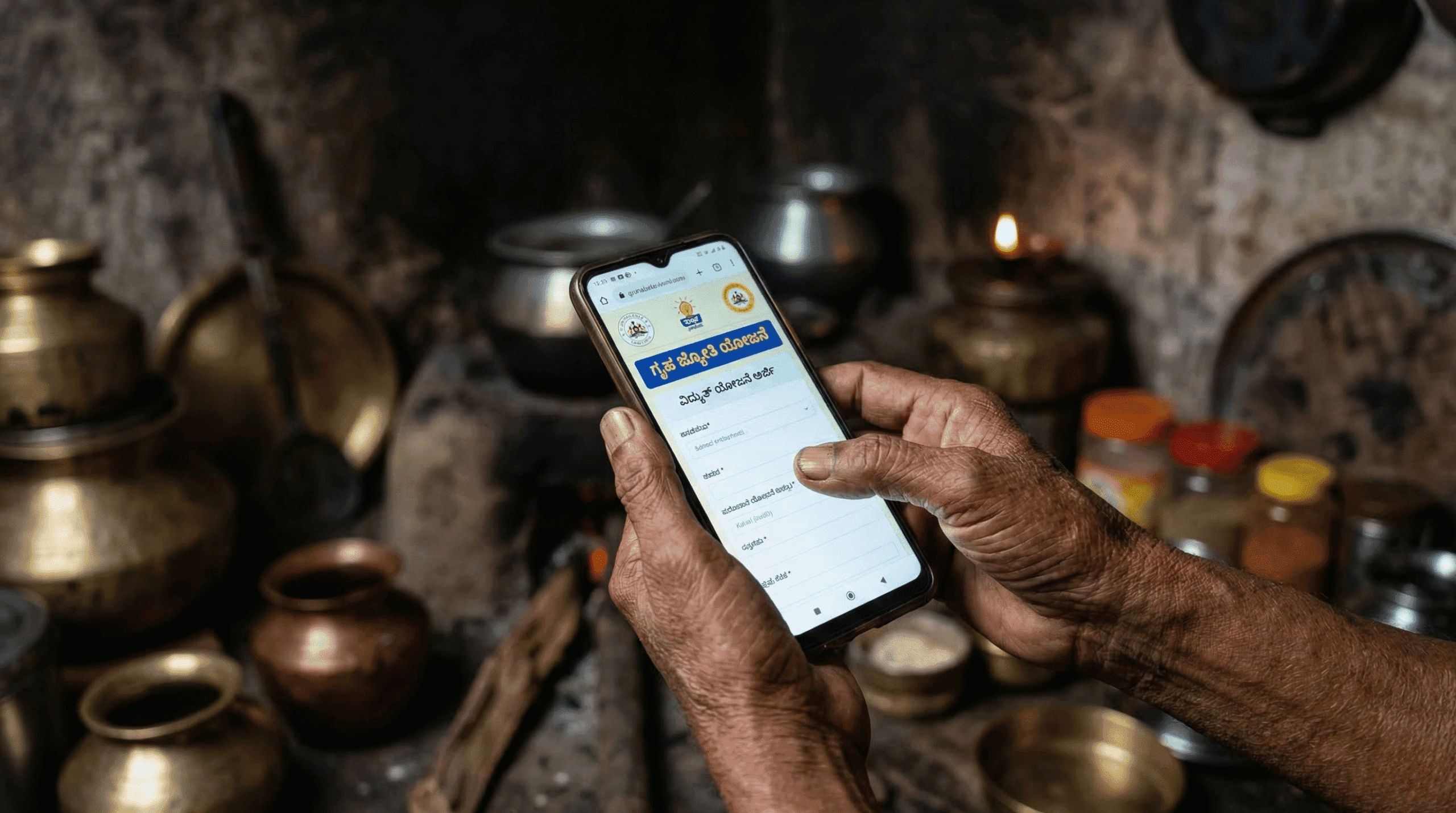
You cannot simply walk into an office and demand your free electricity. You must register through the state’s designated online portal.
Entering the official Seva Sindhu registration portal felt like wrestling with a ghost. The servers were perpetually choked.
I tried logging in at three in the afternoon. Nothing but static.
I set an alarm for two in the morning, hoping to bypass the digital traffic jam. The loading wheel just spun endlessly into the night.
When the page finally rendered, the OTP verification failed to trigger. My phone sat perfectly silent while the session timer aggressively ticked down to zero.
The Aadhaar Mismatch Catastrophe
The most terrifying hurdle is the biometric and demographic verification. Your Aadhaar details must perfectly mirror your electricity board records.
My father’s name on his Aadhaar card includes his full surname. His BESCOM ledger only lists his initial.
That tiny, seemingly insignificant typographical variance triggered an automatic rejection. We were locked out of the system entirely.
Correcting a BESCOM name ledger requires physical affidavits, property tax receipts, and boundless patience. We spent three agonizing weeks sitting on plastic chairs in a stifling government sub-office.
All for a discrepancy of four letters.
The Brutal Reality of Tenant-Landlord Warfare
The most vicious battles are happening behind closed doors. Renters are finding themselves entirely at the mercy of their property owners.
The state mandates that the benefit applies to the resident, not the property owner. But the meter is almost always registered under the landlord’s name.
To claim the subsidy, a tenant must upload a valid, registered rental agreement. Most informal renting arrangements in tier-two cities operate on mere handshakes.
No paperwork means no subsidy. Pure panic.
I watched my friend in Hubballi beg his landlord to sign a formal lease. The landlord flatly refused, fearing taxation audits.
My friend is now paying full commercial rates for a tiny one-bedroom apartment.
The Multi-Meter Mansion Problem
Wealthy property owners face a uniquely frustrating constraint. You can only claim the benefit for a single meter across the entire state.
If you own a primary residence in Mysuru and a vacation home in Coorg, you must choose. The system links everything back to your singular Aadhaar identity.
Many attempted to game the system by registering secondary meters under their children’s names. The government anticipated this.
They deployed strict data-matching algorithms to root out duplicate claims originating from the same property tax identification numbers. The resulting wave of cancellations was swift and merciless.
9 Secrets to Securing a Business Loan in Surat for Aggressive Survival
ESCOM Discrepancies Across the State Map
Not all electricity supply companies operate with the same level of digital competence. The experience varies wildly depending on your geographical coordinates.
Consumers under BESCOM in the capital faced server timeouts but eventually received their zero bills. Down in the coastal belt under MESCOM, the reality looked drastically different.
Meter readers there were historically generating bills manually. The sudden shift to tablet-based billing caused massive data synchronization failures.
For two straight months, residents in Mangaluru received bills showing thousands of rupees in arrears. The local offices blamed a software glitch in the centralized database.
Residents were forced to pay the erroneous amounts just to prevent imminent disconnection. They are still waiting for those refunds to materialize.
The Hidden Trap of Fixed Charges
There is a widespread misunderstanding regarding what is actually free. People assume their entire financial obligation to the grid evaporates.
This is a dangerous misconception. The state covers the energy charges for your approved average usage.
But what about the fixed administrative charges, the fuel adjustment costs, and the mysterious arrears? The messaging around these specific line items was hopelessly blurred.
I received a bill in August for forty-five rupees. It wasn’t for electricity consumed.
It was a residual fuel surcharge from three months prior. Because I ignored it, assuming a zero-bill mandate, I was hit with a late penalty.
That forty-five rupees quickly ballooned into a severe headache. You must scrutinize every single printed line on that piece of paper.
Dealing with Historical Arrears
You cannot enter this new utopia carrying old baggage. The government drew a very aggressive line in the sand regarding past debts.
If you owed a single rupee to your respective ESCOM before July, your application was placed in deep freeze. You had to clear all historical arrears within a strict ninety-day window.
Many families deliberately stopped paying their bills in May, anticipating the rollout. They miscalculated terribly.
Those unpaid May and June bills became immediate liabilities. When September arrived, thousands found their lines physically severed by field workers.
They had to pay the arrears, the late fees, and a hefty reconnection charge just to get the lights back on.
The Strain on the Physical Power Grid
We must look beyond the immediate financial relief to understand the systemic risk. Free electricity fundamentally alters consumer psychology.
When a resource loses its price tag, conservation habits evaporate instantly. We are seeing a massive spike in baseline consumption across the state.
Ceiling fans are left spinning in empty rooms. Old, inefficient water heaters are running for hours on end.
This behavior puts an unimaginable burden on the state’s aging electrical infrastructure. It completely contradicts the Ministry of Power’s national grid guidelines for load management.
The Threat of Unscheduled Outages
The physical wires cannot handle this sudden, artificial surge in continuous demand. Transformers in densely populated neighborhoods are blowing out with alarming frequency.
During the peak evening hours, the voltage drops so low that refrigerator compressors stall. We are trading financial cost for severe reliability issues.
What good is a zero-rupee bill if your house is plunged into darkness for four hours every evening? The state energy department is quietly struggling to purchase enough expensive power from the central grid to fulfill these political promises.
The financial math at the state level is bleeding red.
The Unspoken Verification Audits
Do not assume that an approved application is a permanent victory. The authorities are continuously running background verification scripts.
They are cross-referencing your consumption data with municipal property records. If your house is locked for three consecutive months, they will flag your account.
If your commercial shop is illegally drawing power from your residential meter, the algorithms will eventually catch the anomaly. The penalties for fraud are incredibly severe.
They will retroactively bill you for every single unit consumed since the program’s inception. Plus interest.
Surviving the Application Rejection Loop
If you receive an SMS stating your application was rejected, do not panic immediately. The most common culprit is a backend server timeout during the Aadhaar handshake.
Wait exactly forty-eight hours before attempting a fresh submission. Do not try to brute-force the portal with repeated clicks.
Clear your browser cache, sit close to your Wi-Fi router, and try again precisely at dawn. The network traffic is thinnest between five and six in the morning.
Keep your physical documents spread out on the table. You will have exactly three minutes to input eleven different numerical fields before the session terminates.
It feels like disarming a bomb.
The Long-Term Economic Hangover
This massive subsidy requires unprecedented financial gymnastics from the state treasury. Funds are quietly being diverted from infrastructure development to keep the lights on.
Road repairs in my district have stalled completely. Water pipeline projects are delayed indefinitely.
The money to pay the power generation companies has to come from somewhere. It is being siphoned directly from our civic future.
We are essentially borrowing against our own physical infrastructure to fund today’s political promises. The electricity might be free right now, but the actual cost is silently compounding in the background.
When the treasury finally runs dry, who exactly will be left holding the bill?