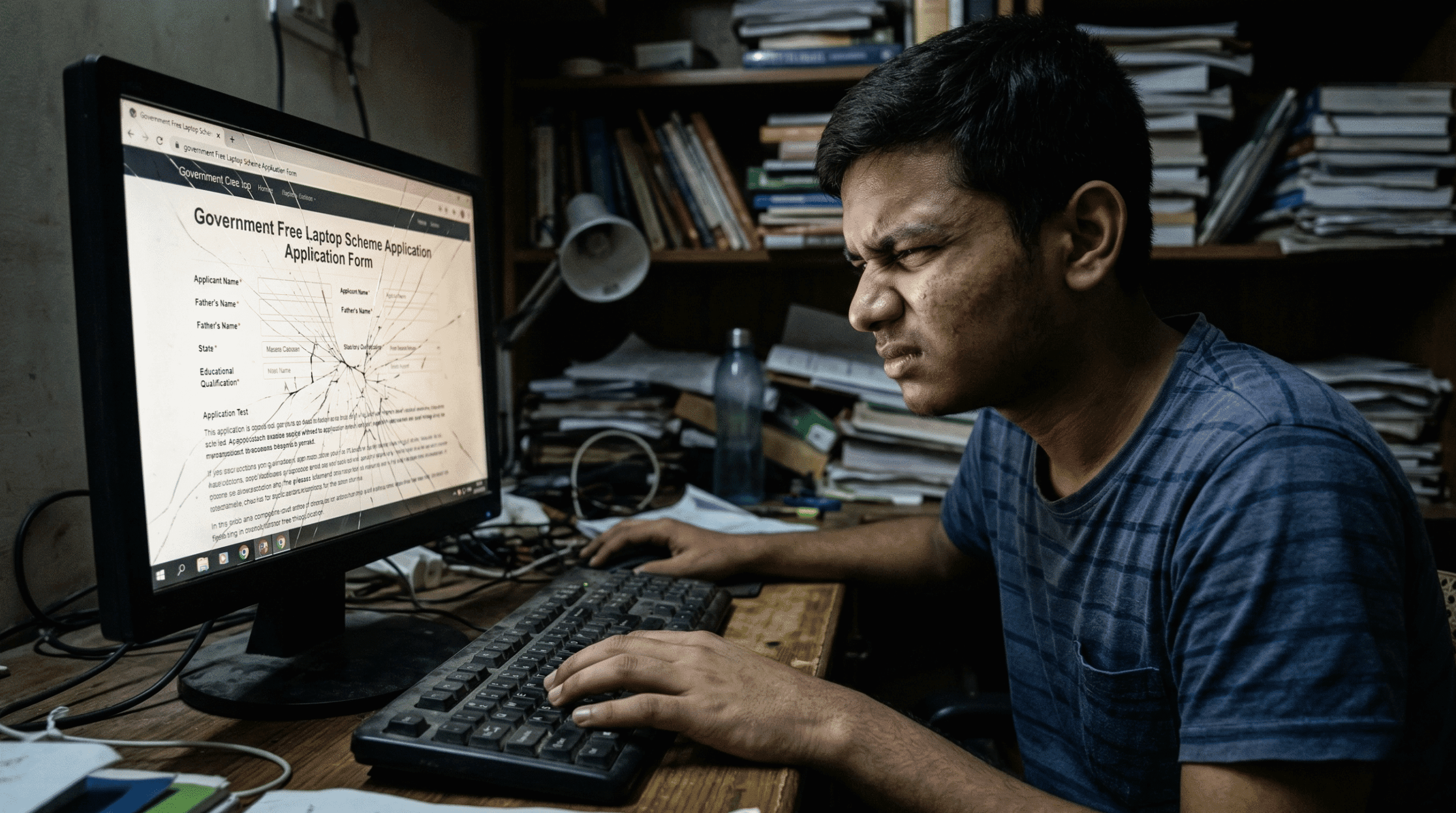
My mouse clicked frantically against the chipped laminate desk at a cramped cyber cafe in Bhopal. The ceiling fan groaned overhead, pushing hot air around the small room while the digital clock on my desktop brutally mocked my progress. The state verification server had just timed out for the sixth consecutive time. And I was completely out of patience. Trying to successfully submit the government free laptop scheme application form felt exactly like dragging wet concrete uphill. Because the digital infrastructure is explicitly built to test your endurance.
You just sit there. Enduring the loading screens. Hoping the local database decides to communicate with your shaky broadband tether. But the system usually responds with systematic refusal. So, you are forced to start the grueling ritual over from scratch.
The reality of state-funded hardware distribution is incredibly harsh. Administrators build these portals with extreme security measures to prevent duplicate claims. Which means legitimate students often get trapped in the crossfire of bad code.
Surviving the government free laptop scheme application form Gauntlet
Most applicants rush into the process completely blind. They gather their basic paperwork, fire up Google Chrome, and assume the interface will guide them. This is a massive mistake. The portal will not hold your hand.
It will actively reject you. Usually without providing a readable error code.
You need to approach this digital barrier like a military extraction. I learned this the hard way after spending three days fighting with the UP Free Smartphone Yojana portal. My session expired repeatedly before I could even upload my signature. The server architecture simply buckled under the weight of a million frantic students.
Why Your First government free laptop scheme application form Gets Rejected
The system acts like an overzealous bouncer at an exclusive club. Your first attempt is almost guaranteed to bounce back. Why? Because of image compression limits.
The submission portal demands your passport photo be strictly under 50KB in JPEG format. Most modern smartphones capture images at roughly 4MB. If you try to force a heavy file into the upload field, the database silently crashes your session.
I watched three different students in that Bhopal cafe throw their hands up in despair over this exact issue. They thought the site was broken. But the site was simply protecting its limited storage capacity by dropping their connections entirely.
You have to manually crush your documents through an aggressive compression tool before you even open your browser. That is the only way to slip past the server’s hostile file-size triggers.
The Hidden Income Certificate Trap
Bureaucracy demands physical proof of your financial suffering. You cannot simply state that your household earns less than the required threshold. You must produce a legally binding document generated by your local Tehsildar.
Procuring this piece of paper is a gauntlet of its own. It requires standing in endless physical queues at the local municipal office. Sweating through your shirt.
But the real trap happens online. When you enter the certificate number into the digital field, the portal immediately queries the state revenue database. If your Tehsildar misspelled a single letter of your surname during the manual data entry phase, the system throws a permanent mismatch error. You are instantly disqualified.
Always cross-reference the exact spelling on your Aadhar card with the ink printed on your income certificate. Even a missing middle initial acts like a locked vault door.
Navigating the UIDAI Verification Maze
Every single state grant relies heavily on your Aadhar number for identity confirmation. But merely typing your twelve digits is entirely insufficient. Your identity must be actively mapped to your bank account through the National Payments Corporation of India (NPCI).
This is where the majority of dreams shatter. Students assume their savings account is ready to receive state benefits. It rarely is.
If your account lacks the specific Direct Benefit Transfer (DBT) flag, the government free laptop scheme application form will flatly refuse to process your request. The portal queries the NPCI server, receives a negative flag, and shuts you out. You must physically visit your bank branch and demand they manually toggle the DBT mapping.
It feels like chewing gravel. But you cannot bypass this financial checkpoint.
Decoding the Hardware: What You Actually Receive
Do not expect a high-end gaming machine to arrive in the mail. The state procures these machines through massive bulk tenders, prioritizing strict budget constraints over rendering performance. You are receiving an educational tool, not a luxury item.
Most recent distribution waves feature models similar to the HP 245 G8 or the Acer TravelMate series. They are entirely functional. But they require immense patience.
You will likely find an Intel Celeron N4020 processor struggling underneath the plastic chassis. Paired with a minimal 4GB of soldered RAM and a restrictive 256GB solid-state drive. It handles heavy web browsing with a noticeable stutter.
And the operating system is rarely what you anticipate. To avoid paying exorbitant licensing fees to Microsoft, many state boards ship these devices pre-loaded with Ubuntu Linux or a severely restricted version of Windows 11 Home Single Language. You will have to adapt your workflow to the software they mandate.
The Realities of Distribution Day
Getting approved is merely the initial skirmish. Actually holding the hardware requires navigating local political theater. The distribution events are heavily publicized affairs designed to generate positive press for local representatives.
You will wait for hours in a crowded auditorium or a dusty college courtyard. Usually in the middle of a brutal summer afternoon.
You must bring your physical approval printout, your original Aadhar card, and your college ID. If the name on your college ID differs slightly from the portal printout, the verification officer will simply skip your name. I saw a girl break down in tears because her surname was abbreviated on her student badge. The administrators showed zero mercy.
They need the paperwork to match flawlessly. Otherwise, the local auditor penalizes them.
Mastering the State-Specific Dashboards
India does not operate a unified portal for these grants. The process fractures heavily depending on your geographic coordinates. The Madhya Pradesh Board of Secondary Education manages an entirely different digital beast compared to the technical education department in Karnataka.
If you live in Uttar Pradesh, you must rely on your college administration to push your data into the DigiShakti portal. You cannot directly interact with the backend yourself. This removes your agency entirely.
You must relentlessly harass your college clerk to ensure your specific spreadsheet row was uploaded correctly. If the clerk takes a sick day during the narrow submission window, your chance evaporates.
7 IIFL Business Loan Customer Care Number Hacks: Unstoppable Relief – PayApprove
Overcoming the government free laptop scheme application form Timeout Errors
Let us talk about browser mechanics. The developers who built these portals implement aggressive session timeouts to reduce server strain. You usually have exactly fifteen minutes to complete the entire data entry process.
If your internet connection stutters, the timer does not pause. It continues bleeding down.
When the timer hits zero, the screen flashes white and kicks you back to the login prompt. All your typed paragraphs vanish into the digital void. This is exactly why you must draft every single text response in a separate Notepad file beforehand.
When the portal finally loads, you simply copy and paste your answers with brutal efficiency. Never type live in the browser. That is asking for a catastrophic failure.
Dealing with the CAPTCHA Menace
The security images generated by these portals are notoriously broken. They frequently render distorted letters that overlap entirely, making them completely illegible to human eyes.
You will squint at a blurry cluster of pixels, trying to differentiate a capital ‘O’ from a number ‘0’. Get it wrong three times, and the system permanently locks your IP address for twenty-four hours. It is a deeply punishing mechanic.
If the image looks even slightly ambiguous, hit the refresh icon immediately. Do not gamble your session on a blurry character. Demand a clear, readable text block from the server before you risk a submission attempt.
Why You Need a CSC Operator on Speed Dial
Sometimes, your home broadband simply lacks the necessary routing privileges to access regional intranet servers. The portal will continuously throw a 502 Bad Gateway warning on your personal machine. But it will load instantly at a registered Common Service Centre (CSC).
These licensed operators utilize dedicated Virtual Private Networks (VPNs) configured specifically for state domains. They bypass the public traffic jams entirely.
Paying the small fifty-rupee fee to a local CSC operator is often the difference between a successful claim and total failure. They know the exact hours when the server load drops. They know which specific browser version the portal prefers. Their local knowledge is a critical asset.
For more details on finding a registered operator, you can verify locations through the CSC e-Governance Services India Limited directory.
Handling the Post-Submission Anxiety
Once you click that final green button, the portal generates a massive, fourteen-digit alphanumeric tracking sequence. Write this down on physical paper instantly. Do not trust a digital screenshot.
If your hard drive crashes or your phone corrupts the image file, you lose your only lifeline to the system.
The tracking portal will likely remain entirely static for months. It will display a generic “Pending at Nodal Officer” status that provides zero comfort. The state operates on geological timeframes. You must forcefully manage your own expectations while the bureaucracy grinds through thousands of physical files.
When the Portal Flags You for Manual Review
Occasionally, the automated database cannot reconcile your academic records. Perhaps your high school board has not pushed the recent passing certificates to the central repository yet. When this happens, your status violently shifts to “Flagged for Manual Verification.”
This is a terrifying notification. It means a human clerk in a distant office now controls your fate.
You will likely receive a cryptic SMS demanding you present physical copies of your mark sheets to a regional education office within forty-eight hours. Drop everything immediately. If you miss this arbitrary window, your application is permanently purged from the active queue.
Always keep three sets of photocopied, self-attested documents neatly organized in a plastic folder. When the state demands proof, you must strike back with overwhelming paperwork instantly. You can refer to the India.gov.in citizen guidelines for proper attestation protocols.
Understanding the Academic Thresholds
The hardware is not a universal entitlement. It is a tightly guarded academic reward. Most states enforce a brutal percentage cutoff that shifts dynamically every single year.
In Madhya Pradesh, falling a single decimal point below the 85% aggregate mark in your 12th board exams automatically triggers a rejection algorithm. There is zero room for emotional appeals. The code simply checks your integer against the state variable and executes a binary decision.
Do not waste your energy fighting the portal if your marks fall short. The database cross-references your roll number directly with the examination board. You cannot manipulate the academic parameters.
The Aftermath of Hardware Ownership
Once you finally secure the device, a new reality sets in. The machine is heavily locked down by enterprise management software. You cannot simply wipe the hard drive and install a clean operating system.
The BIOS is securely password-protected by the state IT department. A persistent wallpaper featuring local political leaders cannot be changed without triggering administrative warnings. The machine constantly reports its location and usage statistics back to a central server whenever you connect to the internet.
It is a tethered asset. A highly monitored tool provided strictly for educational advancement.
Are you actually prepared to surrender your digital privacy for a piece of entry-level computing hardware?