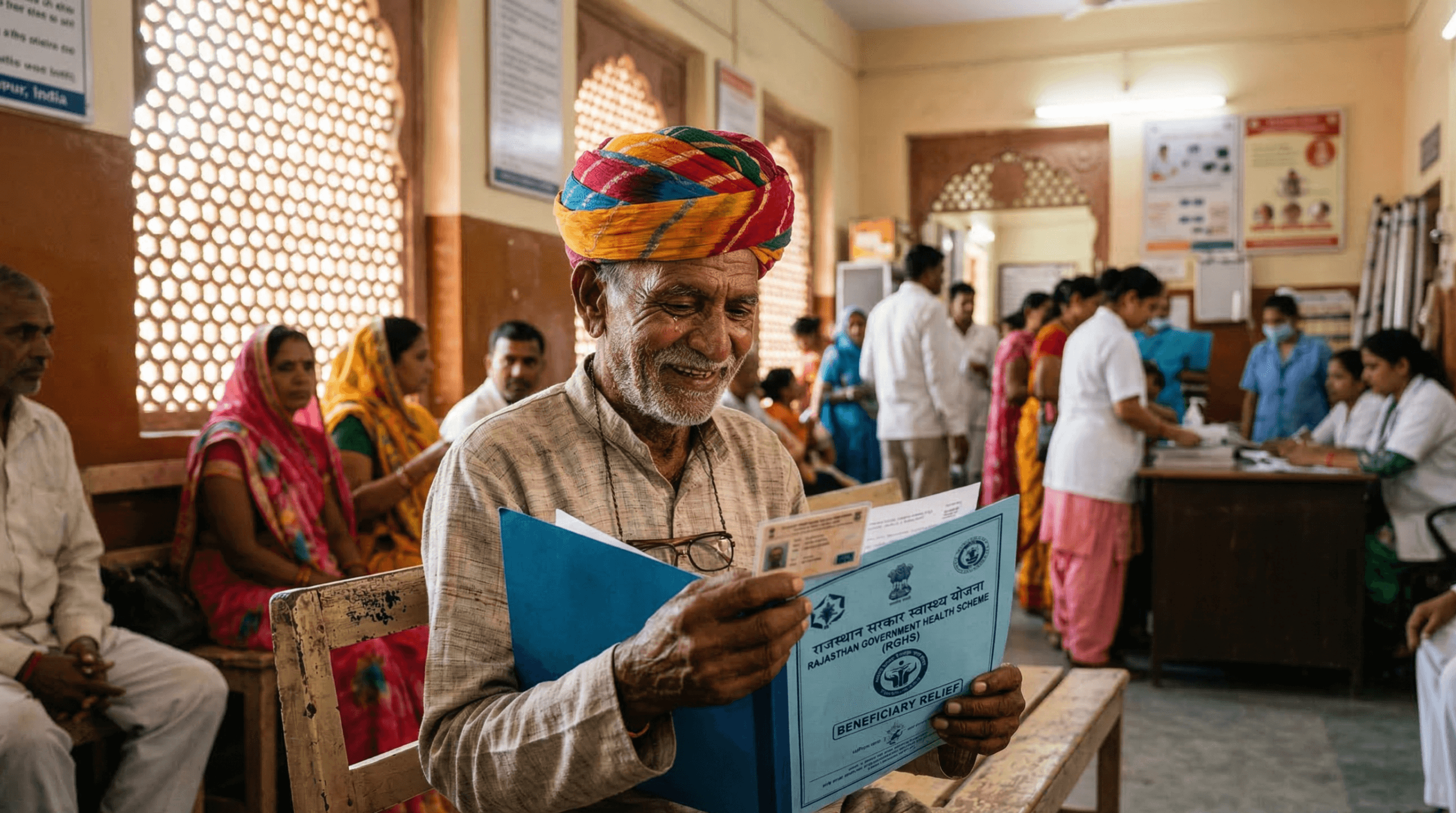
Understanding the rajasthan government health scheme completely erased our massive medical debt. Discover exact eligibility limits and hidden cashless benefits.
My father’s chest pain started precisely at 2:15 AM on a freezing Tuesday in Jodhpur. Panic tasted like rusty pennies in the back of my throat as we desperately navigated the dark streets. We rushed him to the emergency bay at JIET Medical College & Hospital, terrifyingly aware that his retirement bank account held a mere fraction of what an emergency bypass surgery usually costs.
And then, a groggy billing administrator asked a simple, quiet question that instantly erased the suffocating panic in the room. “Do you have your active portal ID?” That tiny digital document was the only thing standing between our family and crippling, multi-generational debt.
The rajasthan government health scheme is not just bureaucratic paperwork designed to gather dust in a file cabinet. It functions as a literal financial tourniquet for state employees and pensioners facing sudden medical disasters. Because absolutely nobody should ever have to trade their life savings just for the privilege of breathing another day.
Who Exactly Qualifies for the Rajasthan Government Health Scheme?
Bureaucracy usually feels like chewing glass. But understanding the exact mechanics of this specific safety net requires dissecting a surprisingly straightforward digital framework. The state designed this medical umbrella to mirror the robust Central Government Health Scheme (CGHS) protocols. Except it exclusively targets local public servants living and working within the state boundaries.
Who actually gets to bypass the cashier’s window and walk straight into the ICU? The eligibility roster covers all current state government employees and pensioners drawing benefits under the standard RCS rules. Ex-members of the Rajasthan Legislative Assembly hold valid coverage indefinitely. Serving AIS officers do, too.
It is a remarkably expansive umbrella. But there is a catch regarding personnel employed under State Autonomous Bodies (SAB).
Employees appointed before the critical cutoff of January 2004 enjoy full hospitalization benefits and aggressive coverage slabs. Those hired after that specific date fall under a completely different Raj Mediclaim structure. A subtle administrative distinction. Yet a brutal one when a sudden illness violently strikes a household.
The Hidden Value Inside the Rajasthan Government Health Scheme Limits
Let us talk raw numbers. Because abstract political promises do not pay for titanium cardiac stents or exhausting chemotherapy sessions. The rajasthan government health scheme allocates a mandatory family floater base of ₹5 lakhs strictly for indoor patient department (IPD) treatments.
If a catastrophic sickness hits your household—think aggressive oncology needs or severe renal failure requiring endless dialysis—an extra ₹5 lakhs unlocks instantly. That is ₹10 lakhs of total breathing room granted without aggressive interrogations. So you never have to delay critical surgical interventions while frantically begging relatives for emergency loans.
Outpatient department (OPD) care holds its own specific monetary allocation. Beneficiaries receive exactly ₹20,000 annually for routine clinic visits, diagnostic blood panels, and daily pharmacy runs. A literal lifesaver for chronic ailments like severe diabetes or volatile hypertension. Truly.
Activating the Lifeline: The SSO Portal Mechanics
You cannot just walk into SMS Hospital in Jaipur, loudly declare your government employment status, and expect free healthcare. The system aggressively demands digital verification before opening any doors. You must secure an active Single Sign-On (SSO) ID and a heavily authenticated Jan Aadhaar card.
Registration feels remarkably friction-free compared to ancient legacy government protocols from a decade ago. You securely log into the official web portal, authenticate your demographic credentials, and instantly generate your beneficiary e-card. That is your ultimate golden ticket.
Without it, you pull out your own credit card. It is that simple.
I remember staring at the portal interface on my phone while my hands shook violently in the Jodhpur waiting room. Fortunately, my father had completed his tedious enrollment months earlier. We just downloaded the verified PDF, shoved my phone screen toward the admission desk, and the terrifying billing meters immediately stopped spinning.
Navigating the Cashless Provider Network
Where can you actually use this heavily guarded coverage? The administration has aggressively integrated a massive network of Health Care Network Providers (HCNP) across every district. This includes massive public institutions like Mahatma Gandhi Hospital alongside hundreds of highly accredited, private medical setups.
From Apex Hospital in Malviya Nagar down to small, specialized empanelled clinics in rural desert districts. The rajasthan government health scheme enforces strict, uncompromising adherence to pre-defined medical package rates. Arrogant private doctors cannot arbitrarily inflate your final invoice just because you look desperate.
They are forced to bill the government directly through a secure gateway. You casually sign a discharge slip. You walk out the front door.
Dealing with Pharmacies and Diagnostics
What exactly happens regarding the expensive medicine you desperately need after surviving the ICU? Beneficiaries legally collect post-care drugs directly from government-owned CONFED stores spread across the state. Alternatively, numerous strictly approved e-pharmacy chains gladly accept the digital prescription.
You snap a photo and upload your doctor’s handwritten note directly through the SSO dashboard. Click the prominently displayed “View Pharmacy” toggle. The absolute nearest authorized medical vendor receives the secure order and dispenses your supply within hours.
Cashless. Seamless. Brilliant.
Read our ultimate guide to upgrading your Jan Aadhaar profile without visiting an E-Mitra kiosk
The Absolute Boundaries of the Program
Nothing is entirely limitless. Assuming this program covers every single random medical expense will lead you directly to a brutal shock at the pharmacy counter. The rajasthan government health scheme maintains a rigidly enforced exclusion framework that rejects frivolous claims automatically.
Cosmetic physical adjustments remain completely off-limits to everyone. Do not expect the state treasury to fund a purely aesthetic rhinoplasty unless it actively repairs severe accidental facial trauma. Experimental medical therapies lacking conventional, peer-reviewed scientific backing will also bounce back instantly rejected.
Similarly, non-prescribed luxury consumables require your own hard cash. Things like premium protein nutritional supplements, imported branded bandages, or luxury private VIP ward upgrades fall entirely outside the safety net. You must request treatments listed strictly within the approved CGHS package codes.
Deviate wildly from the catalog. Pay the harsh penalty yourself.
Comparing Coverage: Chiranjeevi vs. The Employee Model
Public confusion frequently bleeds between the state’s dual, massive healthcare initiatives. The famous Mukhyamantri Chiranjeevi Yojana serves the much broader, massive civilian population of the state. It heavily targets vulnerable families actively holding verified NFSA or SECC 2011 poverty status.
The rajasthan government health scheme caters explicitly and exclusively to the public sector workforce and their direct dependents.
While Chiranjeevi recently boosted its umbrella limits dramatically under specific political conditions, the employee-centric model guarantees significantly broader outpatient allowances. It also locks in specialized CGHS-equivalent care standards that regular civilian plans simply cannot match.
Both massive systems effectively prevent localized financial ruin. But they function on entirely separate, heavily siloed operational tracks. Never confuse your elite employee e-card with a standard Bhamashah or Chiranjeevi enrollment document.
Handling Out-of-State Medical Emergencies
What realistically happens if your aging kidneys violently fail while you are visiting distant relatives in Delhi? The underlying architecture of the rajasthan government health scheme intelligently anticipates unexpected geographical displacement.
Select, highly rated multi-specialty setups outside state borders actively hold valid empanelment contracts. For further information on nationwide hospital standards, you can review the guidelines provided by the National Health Authority. You are not geographically locked to Jaipur, Udaipur, or Bikaner.
If a dire medical emergency demands immediate, life-saving surgical intervention in a completely different state, the framework supports a retrospective reimbursement pathway.
You painfully pay the initial massive invoice yourself to secure your life in the moment. Then, you submit the exhaustive paperwork—discharge summaries, original stamped bills, diagnostic reports—to the internal grievance redressal committee. The bureaucracy will intensely scrutinize the claim.
If it perfectly aligns with emergency protocols, the treasury eventually wires the funds back to your bank account.
Why Some Hospitals Reject the Card
Sometimes the digital system completely chokes. I have personally seen angry, terrified pensioners screaming at reception desks because a specific, trusted nursing home suddenly stopped accepting the e-card overnight. Why does this agonizing friction exist?
Delayed governmental financial disbursements often violently starve private clinics of much-needed operational liquidity. When the slow state treasury lags on clearing massive, multi-crore invoice backlogs, independent hospital wards defensively suspend their cashless portals. It is a harsh, unforgiving operational reality of public-private partnerships.
And innocent patients suffer the immediate, terrifying fallout.
Before wheeling a desperately sick loved one into an emergency bay, verbally confirm their current, active empanelment status with the desk. Do not rely solely on an outdated PDF list downloaded from a WhatsApp group six months ago. Call the administration directly. Verify the active package acceptance before stepping out of your vehicle.
Filing Complaints When the Network Fails You
Sometimes the designated hospital network plays incredibly dirty games. A rogue, aggressive billing manager might quietly demand an illicit “cash deposit” before admitting an active, fully covered beneficiary. This is highly illegal.
The rajasthan government health scheme explicitly bans upfront financial extortion tactics by any of its empanelled corporate partners. You can verify your rights through the Central Government Health Scheme (CGHS) portal which shares identical compliance structures.
When you face this blatant extortion, you do not just surrender your wallet. You fight back aggressively. The state maintains an actively monitored, multi-tiered grievance redressal matrix. You can escalate the illegal denial of service straight to the regional nodal officer.
They operate district-level, state-level, and supreme appellate-level committees designed specifically to heavily penalize non-compliant medical providers. Document the refusal meticulously. Record the verbal interaction secretly if absolutely necessary.
Submit a formal, aggressive dispute ticket through the official portal. I once helped a crying retired school teacher file a severe dispute against a prominent cardiac center in Bikaner. Within exactly forty-eight hours, the terrified hospital administration was frantically calling her personal phone to apologize and process the surgery. The leverage heavily sits in your hands.
The Disease Matrix: Oncology and Orthopedics
We need to honestly talk about the brutal, unforgiving realities of terminal illnesses. Cancer does not care about your scheduled pension payout schedule. Oncology care under the rajasthan government health scheme effectively shields vulnerable families from the ruinous, devastating costs of radiation and modern chemotherapy.
Patients receive immediate, prioritized access to highly targeted biological therapies and expensive PET scans. The system diligently covers the entire exhaustive cycle of a massive medical emergency. From the initial alarming diagnostic blood test to the prolonged, agonizing ICU recovery phase.
Orthopedic calamities also aggressively drain bank accounts within hours. A shattered femur from a highway accident requires expensive titanium implants and weeks of intensive, painful physiotherapy. Beneficiaries completely bypass the terrifying hardware costs.
The state strictly settles the implant invoices directly at pre-negotiated CGHS-approved rates. A massive, undeniable relief for aging, brittle joints.
Gathering the Ammunition for Your Application
Government bureaucracy fundamentally runs on paper. Or rather, high-resolution digital scans. Before you even attempt to securely log into the portal, assemble your documentation perfectly.
The registration algorithm will aggressively reject incomplete profiles without a second moment of hesitation. You absolutely need the Aadhar Card for every single family member you intend to cover. The Jan Aadhaar card acts as the unbreakable primary anchor for the entire massive database.
Secure a recent, brightly lit passport-sized photograph. Keep your PPO (Pension Payment Order) strictly handy if you are a retired veteran. For active serving personnel, your official employee ID and recent stamped salary slip serve as undeniable proof of active duty.
Scan everything in extremely high resolution. Blurry, dark uploads trigger agonizing, weeks-long verification delays. And you absolutely do not want a “pending” profile status when a screaming ambulance is rushing you down the highway.
Maternity Benefits and Pediatric Corridors
Bringing a screaming child into this chaotic world drains your wallet almost instantly in the private sector. The rajasthan government health scheme provides a dedicated, heavily protected financial corridor exclusively for maternity and pediatric care.
Expectant mothers immediately gain access to completely cashless prenatal diagnostics. Essential ultrasounds, specialized fetal blood panels, and routine obstetrician consultations fall effortlessly under the annual OPD limit. When the frantic delivery date finally arrives, the entire hospital admission—whether a standard normal delivery or a highly complex Cesarean section—is entirely subsidized.
Even terrifying neonatal intensive care unit (NICU) daily charges are absorbed quietly by the state if the fragile newborn requires emergency respiratory support or intensive jaundice treatment. Exhausted parents can focus entirely on their crying child instead of frantically swiping credit cards at the sterile billing desk.
Abandoning the Old: The Death of Raj Mediclaim
Before the highly centralized digital portal existed, state employees violently suffered under the antiquated, broken Raj Mediclaim framework. It was a literal nightmare of manual, tedious paperwork and agonizing administrative delays. You had to physically pay the hospital upfront out of your own pocket. Every single rupee.
Then you waited in silence.
You submitted massive physical files to an apathetic, overworked department clerk. The files literally gathered dust on metal shelves for months. Sometimes entire years. The new rajasthan government health scheme completely incinerated that broken, humiliating model.
By aggressively shifting to a strictly cashless, IT-enabled digital ecosystem, the government violently removed the immediate financial burden off the bleeding patient. Reimbursement is no longer the standard primary mechanism. It is the absolute last, desperate resort for extreme out-of-network geographical emergencies.
This aggressive shift represents a massive, undeniable upgrade in basic human dignity. You no longer have to beg the administration for your own money back.
The digital infrastructure expands daily, capturing more private clinics in its invisible web. But as government financial liabilities pile up rapidly against aggressive private hospital invoices, a glaring, terrifying question remains. What happens the day a critical, massive hospital network decides they are no longer willing to wait for the treasury to clear their multi-crore backlog?